Introduction
Spiti Valley sits at roughly 3,800 meters in Himachal Pradesh, a cold desert wedged between Tibet and the rest of the Himalayas, and it's genuinely one of the few places in India where the landscape looks like it belongs on another planet. Bare mountains, whitewashed monasteries a thousand years old, and villages so high up that a couple of them claim to be the world's highest motorable settlements.
The catch with Spiti is that almost nothing about it works the way a regular Indian hill station does. The road you take changes which months you can travel. The temperature swings by 20+ degrees between day and night. And “winter” here doesn't just mean pack a jacket, it means an entirely different trip. Here's what's actually confirmed for 2026 travel.
Table of Contents
- Where Spiti Valley Is and Why It's Different
- Spiti Valley Distance from Delhi (Both Routes Compared)
- Delhi to Spiti Valley Bus: The Complete Breakdown
- Spiti Valley Temperature: Month by Month
- Spiti Valley Places to Visit
- Things to Do in Spiti Valley
- Spiti Valley in Winter: What It's Actually Like
- Best Time to Visit (By Priority)
- Practical Tips
- Common Mistakes
- Frequently Asked Questions
Where Spiti Valley Is and Why It's Different
Spiti sits in the Lahaul and Spiti district of Himachal Pradesh, part of the trans-Himalayan cold desert belt with strong Tibetan Buddhist cultural influence, ancient gompas (monasteries), barley terraces, and landscapes so stark they're often compared to the moon. If you're weighing this against a Sahyadri weekend trek, our Sahyadri vs Himalayan trek comparison breaks down the differences.
What makes planning a Spiti trip genuinely different from planning, say, a Manali trip is that two of its three access roads are seasonal, closing for months at a stretch due to snow. That single fact shapes almost every other decision on this list: which route you take, which season you go in, and even which of Spiti's own villages you can actually reach.
Spiti Valley Distance from Delhi (Both Routes Compared)
There are two roads into Spiti from Delhi, and the distance genuinely differs depending on which one you take.
| Route | Distance | Driving Time | Road Status |
|---|---|---|---|
| Via Shimla (Kinnaur route, NH-5) | ~700 km | 14-18 hours across 2-3 days | Open year-round |
| Via Manali (Kunzum Pass) | ~750 km | 14-18 hours across 2 days | Open only mid-June to early October |
The Shimla-Kinnaur route runs Delhi to Shimla, then through Kinnaur via Rampur, Sarahan, Reckong Peo/Kalpa, and onward through Nako, Tabo, and Pin Valley before reaching Kaza. This road, part of the historic Hindustan-Tibet Highway, stays open all year, which is exactly why it's the only way in during winter.
The Manali route climbs over the Atal Tunnel and Kunzum Pass (4,551 meters), a genuinely dramatic drive, but it's completely snowed shut for roughly eight months of the year, opening only from around mid-June to early October.
A popular option for a longer trip: if you're visiting between June and October when both roads are open, you can do a full circuit, entering via Shimla-Kinnaur and exiting via Manali (or vice versa), rather than backtracking the same road both ways. Outside this window, you must return via the same Kinnaur route you came in on.
Delhi to Spiti Valley Bus: The Complete Breakdown
Public transport to Spiti runs entirely through HRTC (Himachal Road Transport Corporation), with HPTDC running a smaller fleet of tourist Volvo buses mainly for hotel-linked packages. HRTC wins on frequency and reach.
Via Shimla-Kinnaur (year-round option)
- Delhi to Shimla: Overnight HRTC or HPTDC Volvo buses depart from ISBT Kashmiri Gate
- Shimla to Reckong Peo: 13 daily HRTC services, 8-12 hours, fare roughly ₹430-650
- Reckong Peo to Kaza: 2 daily services, 9-10 hours, fare roughly ₹400-700
Via Manali (June to October only)
- Delhi to Manali: Overnight sleeper or Volvo buses (HRTC/HPTDC), roughly 12 hours covering ~570 km
- Manali to Kaza: Daily HRTC morning buses once the road opens, mostly from mid-June. These depart Manali around 5:00 AM (after arriving from Kullu around 4:45 AM), fare roughly ₹500-700, covering the ~202 km stretch over Kunzum Pass
A genuinely useful HRTC detail: the network runs over 3,300 buses across 3,700 routes throughout Himachal, and the semi-sleeper “Himsuta” Volvo seats reportedly recline enough for most riders to get 5-7 hours of actual sleep on the longer overnight legs.
HRTC booking and enquiry numbers: 1800-180-8185 (toll-free), 011-23868694 (Delhi), 01902-252323 (Manali), 01900-222245 (Keylong)
Total trip duration: a comfortable round trip from Delhi via Kinnaur and back typically needs 10-12 days. If doing the June-October circuit (in via one road, out via the other), 10 days is realistic. In winter, since you must return the same way, budget 12-14 days, including buffer time.
Spiti Valley Temperature: Month by Month
Spiti's temperature swings are extreme, both across seasons and within a single day. Here's a genuine breakdown:
| Season | Months | Daytime Temp | Night Temp | Road Status |
|---|---|---|---|---|
| Spring | March-May | 2°C to 8°C (Kaza) | -10°C to -18°C | Shimla route open; Manali route opens ~mid-June |
| Summer | June-September | 15°C to 25°C | 0°C to 5°C | Both routes open; peak tourist season |
| Monsoon | July-August | Mild, since Spiti is a rain-shadow cold desert | Cool | Kinnaur side prone to landslides |
| Autumn | October-November | 5°C to 15°C | -5°C to -10°C | Manali route closes early October |
| Winter | December-February | -5°C to 2°C | -15°C to -30°C | Only Shimla-Kinnaur route open |
A closer look at peak winter (December-February): night temperatures in Kaza commonly drop to -15°C to -25°C, and some sources report lows approaching -30°C in the coldest stretches of January-February. Higher villages like Langza, Hikkim, and Key Monastery, all above 4,100 meters, run several degrees colder still, with March data showing night temperatures as low as -18°C to -22°C even as the calendar edges toward spring.
Important nuance: unlike coastal India, Spiti's monsoon (July-August) is mild rather than disruptive, since the valley sits in a rain shadow. The real monsoon risk isn't Spiti itself, it's the Kinnaur approach road, where landslides around Maling Nala (between Pooh and Nako) are common and can close the route for hours to days at a stretch.
Spiti Valley Places to Visit
Kaza
The administrative headquarters and de facto base camp for the entire valley. Almost every itinerary starts and ends here, and it's where you'll find the most reliable food, fuel, and accommodation options.
Key Monastery
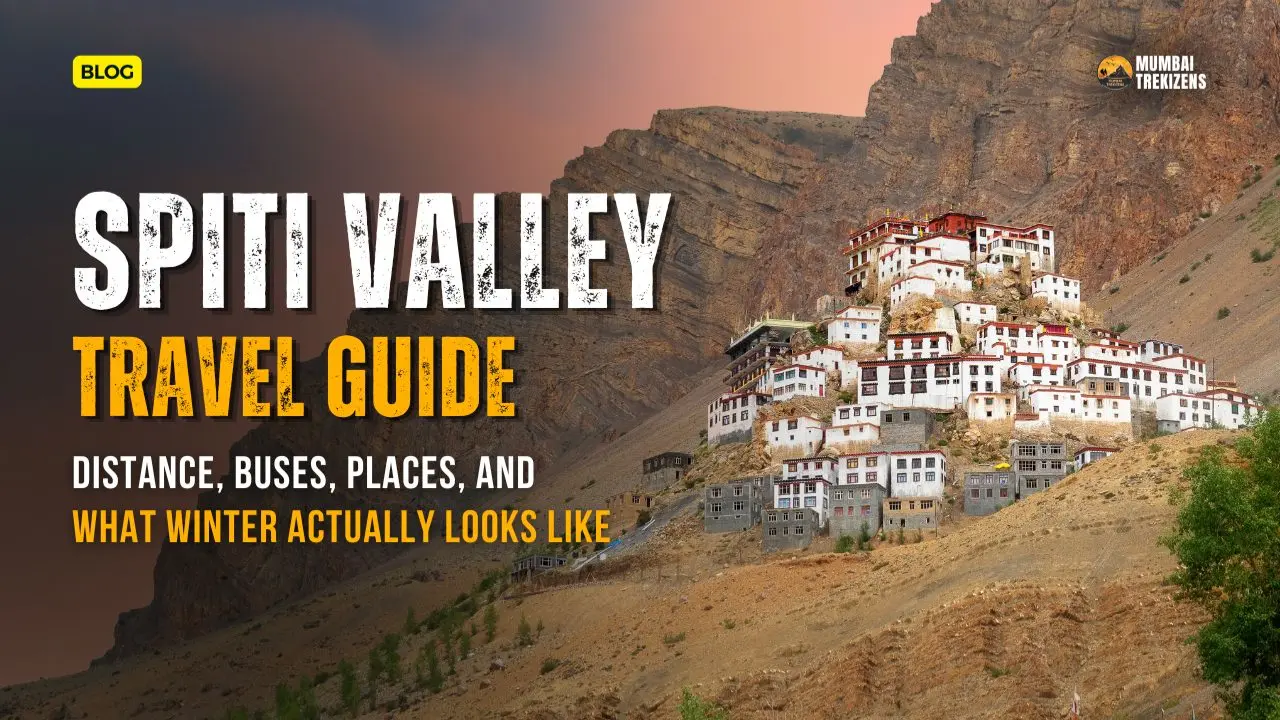
A roughly 1,000-year-old hilltop gompa, one of the largest and most recognizable monasteries in Spiti, home to a resident community of monks and a genuinely striking piece of Himalayan Buddhist architecture.
Tabo Monastery
Founded in 996 AD, Tabo is often called the “Ajanta of the Himalayas” for its extensive collection of centuries-old frescoes and wall paintings, remarkably preserved inside mud-walled structures. It's been considered for UNESCO recognition given its historical significance.
Dhankar Monastery and Dhankar Lake
Perched dramatically on a cliff at the confluence of the Spiti and Pin rivers, “Dhankar” literally translates to “fort on a cliff.” The nearby Dhankar Lake, reachable via a moderate trek, freezes completely in winter, creating a striking contrast against the snow-covered peaks.
Chandratal Lake (“Moon Lake”)
A crescent-shaped high-altitude lake at roughly 4,300 meters, one of Spiti's most photographed spots. This is seasonal in the most literal sense, accessible by road only from around June to September, since Kunzum Pass (the route to it) is snowbound the rest of the year. In winter, it's only reachable via a challenging trek, and even then, the lake itself is frozen solid.
Kibber and Chicham
Among the world's higher-altitude inhabited villages, sitting near the Kibber Wildlife Sanctuary, a genuine hotspot for spotting the elusive snow leopard, particularly in winter when the animals descend to lower elevations searching for prey.
Langza, Hikkim, and Komic
A cluster of high-altitude villages (around 4,400 meters) known for a Buddha statue overlooking the valley (Langza), the world's highest post office (Hikkim), and one of the highest motorable villages on Earth (Komic).
Pin Valley National Park
A protected area known for snow leopard sightings and unique high-altitude flora and fauna, best explored with a local guide.
Things to Do in Spiti Valley
- Monastery visits: Key, Tabo, Dhankar, and Kungri monasteries each offer a genuinely different architectural and spiritual experience
- Stargazing: Spiti's high altitude and minimal light pollution make it one of India's best stargazing destinations. May-September offers the clearest skies, with Komic and Hikkim frequently cited as the best vantage points for the Milky Way
- Snow leopard tracking: A genuinely rare winter activity, done with local trackers around Kibber and Chicham, when the animals move to lower altitudes
- Trekking: Routes ranging from short village walks to the demanding Pin-Parvati and Parang La treks, the latter historically used by villagers to trade yaks across to Ladakh
- High-altitude cycling and biking: Popular during the summer season on the Manali-Kaza stretch, though it demands serious acclimatization
- Trying local food: Thukpa, momos, and butter tea are Spiti staples, genuinely welcome after a cold day of sightseeing
- Camping at Chandratal: A summer-only experience (June-September), camping beside the lake under an exceptionally clear night sky
- Village homestays: Staying with local families in Kaza, Langza, or Comic offers a much closer look at Spitian life than a hotel stay would
Spiti Valley in Winter: What It's Actually Like
This deserves its own section, because winter Spiti isn't a slightly colder version of summer Spiti, it's a genuinely different trip.
What changes:
- Only the Shimla-Kinnaur road is open. The Manali route is completely shut, so there's no circuit option, you go in and come out the same way
- Chandratal is inaccessible by road, and reachable only via a serious winter trek, if at all
- Some villages become genuinely hard to reach. Winter itineraries commonly narrow down to Kaza, Key, Kibber, Langza, Hikkim, Tabo, Dhankar, and Pin Valley, dropping the more remote or high-altitude spots
- Basic utilities get unreliable. Expect frozen water pipes, limited running water, and patchy electricity outside Kaza. Mobile connectivity (BSNL/Jio) works in Kaza but largely disappears elsewhere, expect a genuine digital detox
- Crowds drop dramatically. Some sources describe roughly 90% fewer visitors compared to peak summer season, which is either a major draw or a major inconvenience depending on what you're looking for
Genuine temperature reality: night temperatures commonly fall to -15°C to -30°C depending on the month and location within the valley. Daytime highs might reach a relatively “mild” -5°C to 5°C, still requiring serious layered clothing.
The upside most winter-specific guides point to: near-empty monasteries for quiet, unhurried exploration, dramatically clear cold-season light for photography, frozen lakes and waterfalls (Dhankar Lake, Lingti waterfall) that don't exist in this form any other time of year, and a real shot at spotting snow leopards, something summer visitors essentially never get.
Recommended winter buffer: given that heavy snowfall (typically December-February) can close even the Kinnaur route's most vulnerable stretch (below Dhankar, near Shichilling) for anywhere from 2-3 days to 2-3 weeks, experienced Spiti travelers consistently recommend building in 3-4 buffer days to any winter itinerary. Getting stuck in Kaza for up to a week waiting for a road to reopen isn't a rare traveler's tale, it's a documented, recurring possibility.
Best Time to Visit (By Priority)
- For comfortable weather and full accessibility (including Chandratal): June to September
- For stargazing specifically: May to September, with Komic and Hikkim as prime spots
- For fewer crowds without full winter extremity: March-April or October-November (though both carry cold nights and shifting road conditions)
- For snow leopard sightings and a genuine winter adventure: January to March, accepting that this means the toughest logistics, coldest temperatures, and the most limited village access of the year
Practical Tips
- Acclimatize deliberately. At 3,800m+, altitude sickness is a real risk regardless of season; spend at least a day resting in Kaza before pushing to higher villages like Komic or Hikkim
- Carry cash. ATMs are unreliable to nonexistent outside Kaza
- Layer aggressively even in summer. Daytime warmth can drop 15-20 degrees the moment the sun sets
- Confirm current road status directly with HRTC before finalizing your route, especially during shoulder seasons (May, October-November) when conditions can shift quickly
- Book winter homestays with heating specifically confirmed, since not every property maintains reliable warmth once temperatures drop
- If traveling via Manali route, always double check the season. It's only open roughly mid-June to early October
Common Mistakes to Avoid
- Planning a Manali-route trip outside June-October. The pass is simply closed, no exceptions
- Skipping buffer days in a winter itinerary. Getting stranded in Kaza due to snowfall on the Kinnaur route is a documented recurring issue, not a rare edge case
- Underestimating the cold at higher villages. Kaza's temperature doesn't represent Langza, Hikkim, or Key Monastery, all of which run noticeably colder given their higher elevation
- Assuming Chandratal is accessible year-round. It's a strictly June-September destination by road; outside that window it's snowbound or reachable only via serious trekking
- Not confirming connectivity expectations. Assuming you'll have phone signal throughout the valley is a common and frustrating mistake; outside Kaza, expect little to none
Frequently Asked Questions
1. What is the distance from Delhi to Spiti Valley? Approximately 700 km via the Shimla-Kinnaur route, or approximately 750 km via the Manali route, with both taking around 14-18 hours of total driving spread across 2-3 days.
2. Is there a direct bus from Delhi to Spiti Valley? Not a single direct bus. You'll take an HRTC or HPTDC overnight Volvo from Delhi to Shimla or Manali, then connect via HRTC buses onward to Kaza, changing buses at Reckong Peo (Shimla route) or directly from Manali (summer route).
3. What is the temperature in Spiti Valley in winter? Night temperatures commonly range from -15°C to -25°C, occasionally approaching -30°C in the coldest months (January-February), while daytime highs might reach only -5°C to 5°C.
4. Is Spiti Valley open in winter? Yes, but only via the Shimla-Kinnaur route, since the Manali route through Kunzum Pass is completely closed by snow from around October to June. Some remote villages and Chandratal Lake become inaccessible in winter.
5. What are the best places to visit in Spiti Valley? Kaza, Key Monastery, Tabo Monastery, Dhankar Monastery, Chandratal Lake (summer only), Kibber, Langza, Hikkim, and Pin Valley National Park are the most commonly visited destinations.
6. What are the best things to do in Spiti Valley? Monastery visits, stargazing (especially at Komic and Hikkim), snow leopard tracking in winter around Kibber and Chicham, trekking, and staying in local village homestays are among the top experiences.
7. When is the best time to visit Spiti Valley? June to September offers the most comfortable weather and full accessibility, including Chandratal Lake. January to March suits travelers specifically seeking a winter adventure with snow leopard sighting potential, accepting extreme cold and limited access.
8. How many days are needed for a Spiti Valley trip from Delhi? A comfortable round trip via the Kinnaur route takes 10-12 days. A summer circuit (Kinnaur in, Manali out, or vice versa) can be done in around 10 days. Winter trips need 12-14 days, including buffer time for potential snow-related road closures.
Spiti Valley rewards planning more than almost any other Indian destination, because so much of the experience genuinely depends on which road is open, which month you're traveling in, and how much cold you're prepared for. The Shimla-Kinnaur route gets you there year-round; the Manali route only works from June to October but adds a dramatic circuit option. Summer gives you Chandratal and full village access; winter gives you empty monasteries, frozen lakes, and a real shot at spotting a snow leopard, at the cost of serious cold and unpredictable road closures.
Neither version of Spiti is the “better” one. They're genuinely different trips wearing the same name, and knowing that going in is what separates a smooth Spiti journey from one spent stuck at a landslide waiting for BRO to clear the road. Planning a Char Dham trip too? Our Kedarnath Yatra 2026 guide covers similar seasonal planning for that route.
Ready for Your Next Adventure?
Don't just read about it — come experience it. Book your spot on Himalaya Treks with certified trek leaders, small groups, and everything organised for you.
🏷 Spiti Valley, Delhi to Spiti Valley bus, Spiti Valley distance, Spiti Valley places to visit, Spiti Valley temperature, Spiti Valley in winter
Be the first to comment on this post.