Introduction
Every serious trekker in Mumbai or Pune eventually asks the same question: after doing a dozen weekend treks in the Sahyadris, are you actually ready for the Himalayas? It's a fair question, and the honest answer is: partly, but not in the way most people assume.
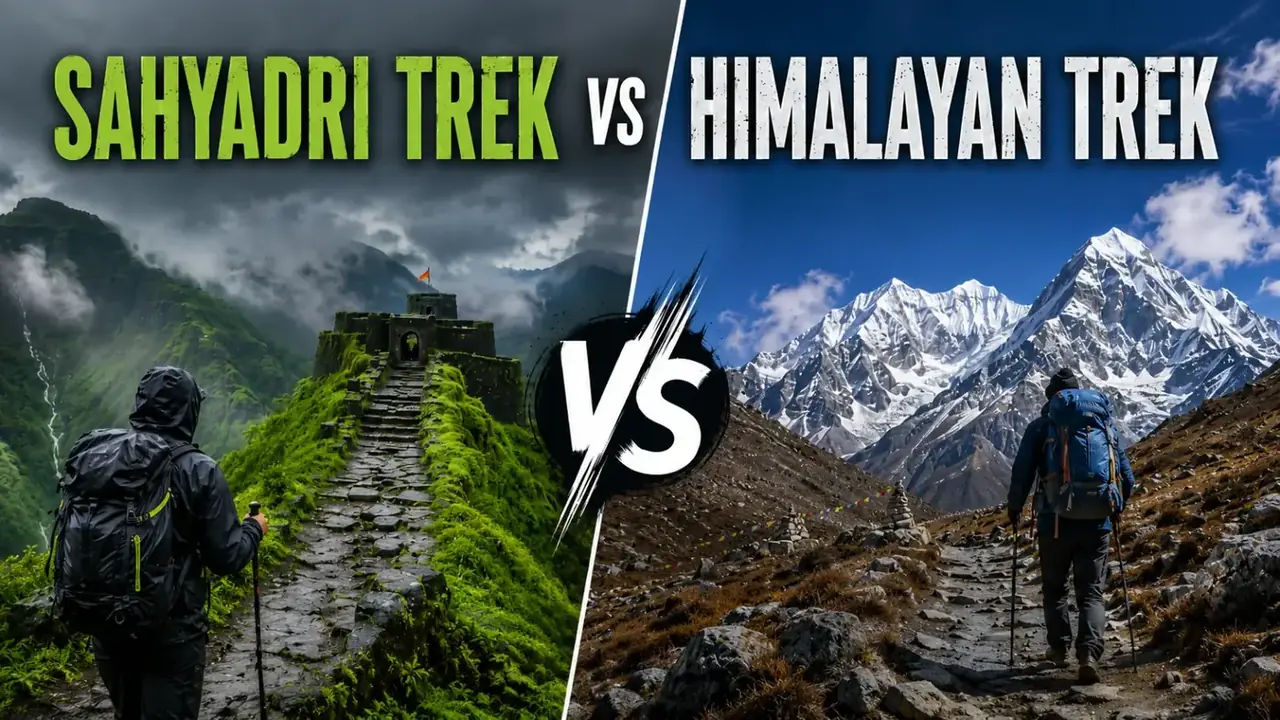
The Sahyadris and the Himalayas aren't just "smaller mountains" and "bigger mountains." They're different trekking experiences built around different risks, different costs, and different kinds of preparation. This guide breaks down the real, verifiable differences, altitude, terrain, cost, safety, and what actually transfers from one to the other, so you know exactly what changes when you make that jump.
Table of Contents
- Altitude: The Numbers That Actually Matter
- Terrain and Trail Type
- Weather Predictability
- Difficulty Grading: How Each Region Measures It
- Duration and Time Commitment
- Cost Comparison
- Altitude Sickness: The Risk Unique to the Himalayas
- What to Pack: A Real Difference
- Physical Preparation Required
- Which Should You Choose First
- What Sahyadri Trekking Actually Prepares You For
- Practical Tips
- Frequently Asked Questions
Altitude: The Numbers That Actually Matter
This is the single biggest structural difference between the two regions, and it explains almost everything else on this list.
- The highest peak in Maharashtra is Kalsubai, at 5,400 feet (1,646 meters). That's the ceiling for the entire Sahyadri range.
- Most Himalayan treks start where the Sahyadris end. Beginner-friendly Himalayan treks typically begin at 7,000 to 9,000 feet, and popular routes like Hampta Pass cross passes at 14,100 feet, while high-altitude treks like Everest Base Camp reach 18,200 feet (5,364 meters).
It's tempting to assume higher altitude automatically means a harder trek, but that's not entirely accurate. Distance covered per day, trail type, and weather all factor in too. What altitude does add, reliably, is a physiological challenge that simply doesn't exist in the Sahyadris: reduced oxygen, which changes how your body performs regardless of how fit you are.
Terrain and Trail Type
Sahyadri terrain is built around hill forts, plateaus, and monsoon-fed valleys. Expect laterite rock, forest cover, seasonal streams, and rock-cut steps carved into fort approaches (Harihar Fort's 117-step staircase being the most extreme example). Trails are generally well-trodden and short enough to complete in a single day.
Himalayan terrain varies far more by region and season. Depending on the trek, you'll cross alpine meadows, moraine, scree, river crossings, snowfields, and occasionally glaciated sections on the more difficult routes. Trail conditions change dramatically by season, a trail that's a grassy meadow in September can be under snow in December.
Weather Predictability
Sahyadri weather runs on three fairly predictable seasons: monsoon (June to September, the busiest trekking season), winter (October to February, cool and clear), and summer (March to May, generally avoided for trekking due to heat).
Himalayan weather is considerably less predictable, and it can shift within hours regardless of season. As one Mumbai-based trekking group leader is known to put it during briefings: mood in Mumbai and weather in the mountains can both change without warning. Even on Himalayan treks with a low forecasted chance of rain, carrying a poncho or raincoat is standard practice, because conditions genuinely can flip that fast. Our Spiti Valley travel guide shows just how extreme winter conditions can get there.
Difficulty Grading: How Each Region Measures It
Sahyadri treks are usually graded informally: easy, moderate, or difficult (occasionally "strenuous"), based mostly on distance, elevation gain, and terrain type. Alang Madan Kulang (AMK) and Sandhan Valley, both requiring rappelling and technical skill, sit at the top of that scale in Maharashtra, but even these are typically single or two-day commitments.
Himalayan treks use a more structured grading system, generally built around:
| Grade | Duration | Altitude | Trail Type |
|---|---|---|---|
| Easy | Short days, ~5 hrs/day | Within 13,000 ft (4,000m) | Wide, well-defined trail, soft terrain |
| Moderate | Multiple days | 13,000-16,000 ft range | Some technical sections, baseline fitness needed |
| Difficult | 8-15 days | 4,500-6,000m (up to ~20,000 ft) | Undefined trail, boulders, scree, snow, ice |
| Expedition | Multi-week | Above 5,000m (16,400 ft) | Glaciated, crevassed terrain, technical skill required |
This structured grading exists precisely because Himalayan treks carry risks, altitude sickness, glacier travel, extreme cold, that simply aren't part of the Sahyadri trekking equation.
Duration and Time Commitment
Sahyadri treks are overwhelmingly single-day affairs, with a small number of two-day options (like AMK or an overnight Rajmachi trip). You leave Friday night or early Saturday and you're back home by Sunday evening at the latest.
Himalayan treks typically run 4 to 10 days for moderate routes, and up to 13-15 days for high-altitude expeditions like Everest Base Camp or the Manaslu Circuit. This isn't just a longer version of a weekend trek, it fundamentally changes the experience: no mobile network for days at a stretch, full immersion in the trail, and a different kind of bonding with your trekking group that a single-day trek rarely produces. Many Indian trekkers start with a pilgrimage-style multi-day trek like the Kedarnath Yatra.
Cost Comparison
This is where the two experiences diverge sharply, and it's worth being specific rather than vague about it.
| Trek Type | Typical Cost |
|---|---|
| Sahyadri trek, with a trekking group | ₹1,000-1,500 per trek |
| Sahyadri trek, independent (no group) | ₹500-1,000 per trek |
| Indian Himalayan trek (6-8 days), domestic operator | ₹15,000-35,000 |
| Nepal teahouse trek, independent budget | ₹2,000-3,500 per day |
| Everest Base Camp, Indian operator package | ₹1,20,000-1,80,000 |
| Everest Base Camp, independent (higher risk) | ₹1,00,000-1,25,000 |
The cost gap isn't just about distance and logistics. Himalayan trek pricing reflects permits, licensed guides trained in altitude sickness response, porter support, teahouse or camping infrastructure, and, on the more serious routes, mandatory high-altitude insurance covering helicopter evacuation, which can cost ₹2,50,000 to ₹8,40,000 out of pocket if you're not covered.
Altitude Sickness: The Risk Unique to the Himalayas
This is arguably the most important safety difference between the two regions, and it's one Sahyadri trekking simply doesn't prepare you for, because the altitude never gets high enough to trigger it.
Acute Mountain Sickness (AMS) becomes a real possibility above roughly 10,000 feet, regardless of how physically fit you are. Studies across Himalayan trekking destinations report AMS incidence ranging from 22% to 68%, depending largely on how fast a trekker ascends. This is exactly why well-designed Himalayan itineraries build in dedicated acclimatization days, rather than rushing straight to altitude.
Since Maharashtra's highest point tops out at 5,400 feet, well below the altitude where AMS typically begins, Sahyadri trekkers genuinely have no direct experience managing this risk before their first Himalayan trek. This is worth taking seriously rather than assuming general fitness will cover it.
What to Pack: A Real Difference
For a Sahyadri trek, a water bottle, some snacks, and basic rain protection is often genuinely enough for a day trip.
For a Himalayan trek, your backpack can reasonably weigh 7-10 kg on a 4-6 day trek, factoring in layered clothing for temperature swings, a proper sleeping bag, altitude medication, water purification, and cold-weather gear that simply has no equivalent in Sahyadri packing lists.
Physical Preparation Required
You can reasonably attempt a Sahyadri trek with little to no dedicated preparation, and most people do fine. The Sahyadris are forgiving that way.
Himalayan treks are a different story. Reduced oxygen at altitude means your body works harder for the same effort, and showing up unprepared doesn't just make the trek harder, it can genuinely derail it. Building cardiovascular fitness and lung capacity beforehand, through running or similar aerobic training, is widely recommended by Himalayan trek operators specifically because being under-prepared at altitude leads to exhaustion that undermines the entire trip, not just discomfort.
Which Should You Choose First
- If you've never trekked before: start in the Sahyadris. Low stakes, low cost, forgiving terrain, and a good way to find out if you actually enjoy trekking before investing in expensive Himalayan gear.
- If you've done a handful of Sahyadri treks and want more: an easy-grade Himalayan trek (within 13,000 ft, well-defined trail) is a reasonable next step, not a jump straight to a difficult-grade route.
- If you're specifically training for a difficult Himalayan trek: Sahyadri trekking helps build general fitness and trail confidence, but it cannot simulate altitude, so factor in separate cardio training and, ideally, at least one moderate-altitude trek before attempting anything difficult-grade.
What Sahyadri Trekking Actually Prepares You For
It's worth being honest about this instead of overselling it. Sahyadri trekking builds:
- General trail fitness and comfort with uneven, rocky terrain
- Basic monsoon trekking skills, wet rock, stream crossings, slippery descents
- Trail discipline and group trekking etiquette
- Confidence with rock scrambling on treks like Harihar Fort or Sandhan Valley
It does not prepare you for altitude physiology, multi-day cold-weather camping, or the mental endurance required for a 10+ day trek far from network coverage. Treat it as a genuinely useful foundation, not a substitute for Himalaya-specific preparation.
Practical Tips
- If you're planning your first Himalayan trek, choose an easy-grade route and avoid jumping straight to anything above 13,000 feet
- Build cardio fitness for at least 4-6 weeks before a moderate or difficult Himalayan trek
- Get travel insurance that specifically covers high-altitude trekking and emergency evacuation; standard travel insurance often excludes anything above 4,000 meters
- For your first multi-day trek, choose a route with built-in acclimatization days rather than the shortest, cheapest itinerary
- Inform family of expected network gaps before a Himalayan trek, since connectivity can disappear for days at a stretch
Frequently Asked Questions
1. Is Sahyadri trekking good practice for Himalayan trekking? It builds general fitness, trail confidence, and monsoon trekking skills, but it doesn't prepare you for altitude sickness risk or multi-day cold-weather conditions, since Maharashtra's highest point (5,400 ft) is well below where altitude effects typically begin.
2. How much does a Himalayan trek cost compared to a Sahyadri trek? A Sahyadri trek typically costs ₹500-1,500 depending on whether you go independently or with a group. A 6-8 day Indian Himalayan trek through a domestic operator generally costs ₹15,000-35,000, while international treks like Everest Base Camp can run ₹1,20,000-1,80,000.
3. Is altitude sickness a risk in Sahyadri trekking? No, altitude sickness (AMS) generally isn't a concern in the Sahyadris, since the range's highest peak is only 5,400 feet, well below the roughly 10,000-foot threshold where AMS typically starts becoming a real risk.
4. Which is harder, a Sahyadri trek or a Himalayan trek? It depends on the specific trek. A single-day Sahyadri trek is generally less demanding overall than a multi-day Himalayan trek, but some Sahyadri routes (like Alang Madan Kulang or Sandhan Valley) are technically difficult in their own right. Himalayan difficult-grade treks add altitude, multi-day endurance, and technical terrain that most Sahyadri treks simply don't involve.
5. Do I need special gear for a Himalayan trek that I wouldn't need in the Sahyadris? Yes. Himalayan treks typically require layered cold-weather clothing, a proper sleeping bag, altitude medication, and a heavier pack (7-10 kg for a 4-6 day trek), compared to a light daypack that's usually enough for a Sahyadri trek.
6. How many Sahyadri treks should I do before attempting a Himalayan trek? There's no fixed number, but most experienced trekkers recommend having a handful of moderate Sahyadri treks under your belt to build basic fitness and trail confidence before attempting even an easy-grade Himalayan trek.
7. What is the best season for Sahyadri treks versus Himalayan treks? Sahyadri trekking peaks during monsoon (June-September) and winter (October-February). Himalayan trekking seasons vary more by region, with winter (December-February) popular for guaranteed snow on routes like Kedarkantha, and spring/summer (March-June) opening up higher-altitude routes.
The Sahyadris and the Himalayas aren't a smaller and bigger version of the same activity, they're genuinely different experiences shaped by altitude, weather, cost, and risk. Sahyadri trekking is where most Indian trekkers rightly start: forgiving, affordable, and accessible most weekends of the year. The Himalayas ask for more: real preparation, real budget, and real respect for altitude.
Neither is "better." What matters is knowing exactly what changes when you make the jump, so your first Himalayan trek is a genuine step up, not an underprepared gamble.
Ready for Your Next Adventure?
Don't just read about it — come experience it. Book your spot on Himalaya Treks with certified trek leaders, small groups, and everything organised for you.
🏷 Sahyadri trek vs Himalayan trek, difference between Sahyadri and Himalayan trekking, Himalayan trek cost India, altitude sickness Himalayan trek
Be the first to comment on this post.