Introduction
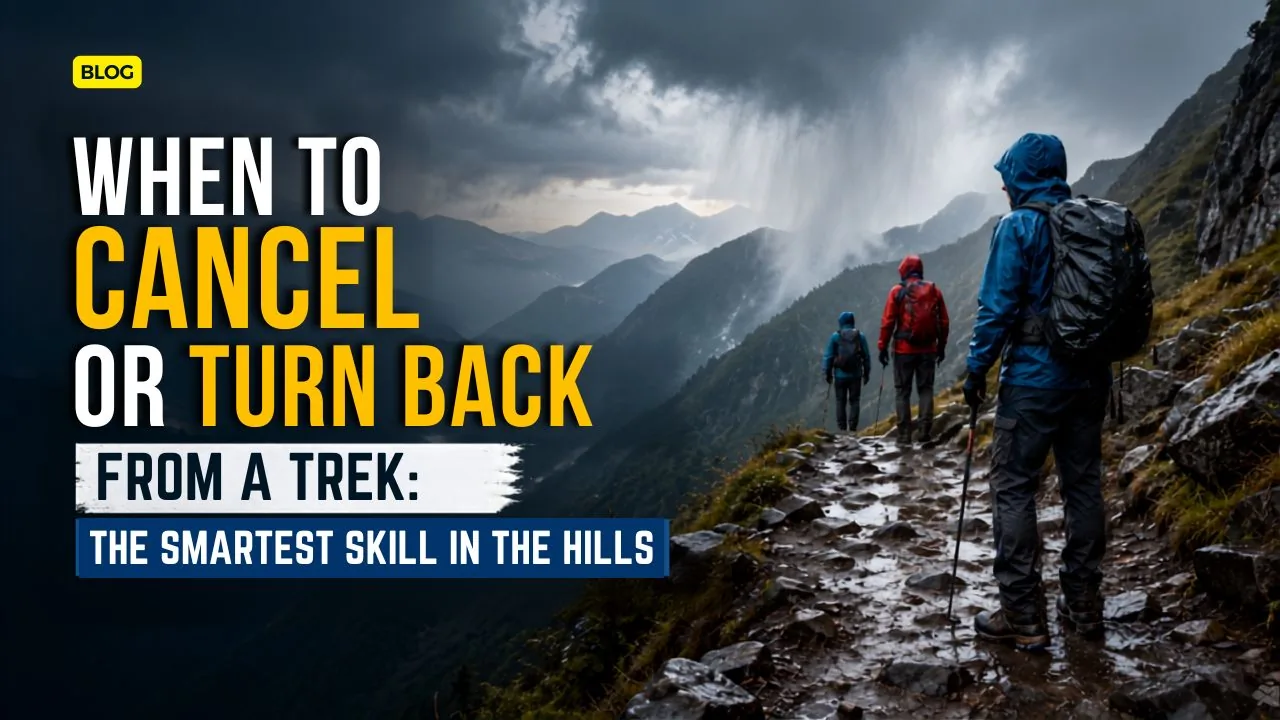
Every experienced trekker will tell you the same thing: knowing when to cancel or turn back from a trek is not a weakness, it's one of the most important skills you can have. The mountains reward good judgment far more than they reward stubbornness.
Turning back can feel disappointing in the moment, especially when the summit is close. But the trekkers who enjoy the hills for decades are the ones who learned early that the mountain will always be there next weekend. A smart retreat today means many more good treks ahead.
This guide gives you clear, practical rules for the toughest decision in trekking. You'll learn the warning signs, how to set a turnaround time, and how to make the call calmly, before enthusiasm outvotes good sense.
Table of Contents
- Why Turning Back Is a Skill, Not a Failure
- Cancel Before You Start: Warning Signs at Home
- Reason 1: Heavy Rain and Bad Weather
- Reason 2: Injury or Illness in the Group
- Reason 3: Low Visibility and Fog
- Reason 4: Route Confusion or Getting Lost
- Reason 5: Exhaustion and Running Out of Time
- The Turnaround Time Rule
- How to Make the Decision Calmly
- Practical Tips
- Common Mistakes
- Expert Insights
- Frequently Asked Questions
- Ready for Your Next Adventure?
Why Turning Back Is a Skill, Not a Failure
There's an old saying in the mountains: reaching the summit is optional, getting back down is mandatory. The goal of any trek is to come home safe and happy, not to reach a specific point no matter what.
New trekkers sometimes see turning back as quitting. Experienced ones see it as reading the situation correctly and choosing the wise path. Those are very different mindsets, and the second one keeps you trekking for life.
The best part: when turning back is treated as a normal, respected option from the start, the decision becomes easy. There's no ego, no argument, just a calm call and a walk back down with the day's memories intact.
Cancel Before You Start: Warning Signs at Home
The easiest trek to turn back from is one you never start. Some conditions are clear enough the night before or the morning of to justify calling it off or rescheduling.
Consider canceling or rescheduling when:
- IMD has issued an orange or red alert for your trek's region.
- Thunderstorms are forecast across your whole trek window.
- A key group member is unwell or clearly not up to it.
- Heavy rain has fallen upstream and your route involves major stream crossings.
- You can't start early enough to finish safely in daylight.
Rescheduling from home costs nothing but a little disappointment. The trail will be greener and safer another day, and a canceled trek under a red alert is a decision you'll never regret.
Reason 1: Heavy Rain and Bad Weather
Weather is the most common reason to turn back mid-trek. Monsoon treks are beautiful, but conditions can shift fast.
Turn back when:
- Rain becomes heavy enough to flood trails or reduce your footing to a slide.
- Thunder starts, signaling lightning within range, especially on exposed tops.
- Streams are rising and you'd be trapped on the wrong side.
- Wind on exposed ridges becomes strong enough to affect balance.
Light rain on a monsoon-friendly trail is part of the fun and no reason to stop. It's the shift to genuinely heavy rain, storms, or rising water that signals a retreat. When thunder rolls in near an exposed summit, heading down is simply the right move. Many bad-weather calls can be made at home — see how to run weather checks before a Sahyadri trek.
Reason 2: Injury or Illness in the Group
If someone in the group gets hurt or falls ill, the situation changes for everyone. A sprained ankle, a bad fall, dizziness, or signs of heat exhaustion all call for a careful reassessment.
Turn back when:
- Someone can't walk comfortably or safely.
- A person shows signs of heat exhaustion, severe cramps, or serious dehydration.
- Anyone feels faint, disoriented, or unwell in a way that rest doesn't quickly fix.
- An injury would only get worse if pushed further.
The group moves at the pace of its most affected member. Pushing on with an injured person to "not waste the trek" almost always makes things worse. Stabilize, support, and head down toward help. When an injury or illness looks serious, prioritize getting the person to professional medical care, since the right response varies from person to person.
Reason 3: Low Visibility and Fog
Thick fog is deceptively serious, especially on open plateaus and near edges. It hides the trail, the drops, and your sense of direction all at once.
Turn back or wait when:
- Fog is dense enough that you can't see the trail ahead or your markers.
- You're on an exposed plateau or ridge where drifting off-route is easy and edges are near.
- Visibility drops so far that the group can't stay together safely.
Sometimes the answer is to wait for fog to lift rather than turn back completely, if you're in a safe spot. But pushing forward blind on unfamiliar, exposed ground is how people wander off-trail. If you can't see where you're going, don't keep going.
Reason 4: Route Confusion or Getting Lost
If the trail stops making sense, stop moving. Continuing while unsure usually makes things worse, taking you further from the known path.
Turn back or pause when:
- You've lost the trail and can't quickly relocate it.
- The route doesn't match your map or memory.
- You've been pushing on hoping it'll "sort itself out" without success.
The rule when lost is simple: stop, stay calm, and if you can't confidently find the way forward, retrace your steps to the last point you were sure of. Backtracking to known ground beats forging ahead into the unknown. This is exactly where a guide or someone who knows the route removes the problem entirely, which is a strong reason to trek unfamiliar routes with people who know them.
Reason 5: Exhaustion and Running Out of Time
Fatigue and fading daylight are quieter dangers than storms, but they catch out plenty of trekkers. Tired legs slip more, tired minds decide worse, and darkness turns an easy descent into a hazard.
Turn back when:
- A group member is genuinely exhausted, not just tired.
- You're clearly not going to summit and descend with daylight to spare.
- The pace has slowed so much that finishing safely is in doubt.
- You've passed your turnaround time (more on that next).
There's no glory in a summit reached at dusk with an exhausted group facing a descent in the dark. Recognizing "we don't have time for this safely" is mature trekking, and it keeps the day a good memory.
The Turnaround Time Rule
The turnaround time is the single best tool for making the summit decision easy. It's a time you set in advance, and if you haven't reached the top by then, you turn around no matter how close you are.
How to use a turnaround time:
- Work backward from the time you must be safely down (well before dark).
- Set a specific clock time for reaching the summit, allowing for the descent.
- Commit to it before you start, as a group.
- When the time comes, turn around, even if the top looks close.
The power of a turnaround time is that you make the decision when you're calm and rational, not when you're tired and summit-focused near the top. It removes the in-the-moment temptation to push "just a bit further." Experienced leaders swear by it. On long climbs like the Salher Fort trek, a fixed turnaround time is essential.
How to Make the Decision Calmly
Good decisions come from a calm process, not a heated trailside debate. Here's a simple way to make the call.
- Pause and assess. Stop, breathe, and look at the facts: weather, group condition, time, terrain.
- Name the concern out loud. Saying "the streams are rising" or "we're behind time" clarifies things for everyone.
- Default to caution. If it's genuinely a close call, the safe choice is to turn back.
- Decide as a group, but let experience lead. A designated leader or the most experienced member should make the final call.
- Commit without regret. Once decided, walk back down positively. Second-guessing helps no one.
Agreeing at the start that turning back is always an acceptable outcome removes ego from the moment. Nobody has to "give up," the group simply reads the situation and chooses well.
Practical Tips
- Set a turnaround time before every summit trek and stick to it.
- Reschedule from home under orange or red weather alerts.
- Watch the weakest and slowest member, and set the pace to them.
- Turn back at the first thunder on exposed tops.
- Backtrack to known ground the moment the trail stops making sense.
- Carry a headlamp so a delay never means being caught in total darkness.
- Agree as a group that turning back is always okay, before you start.
- Trust your trek leader's call; experienced leaders read these signs constantly.
Common Mistakes
- Summit fever: pushing for the top because it's close, ignoring time, weather, or fatigue.
- Ignoring a turnaround time once it arrives.
- Pressing on with an injured or exhausted member rather than heading down.
- Continuing into thick fog on exposed ground instead of waiting or retreating.
- Forging ahead when lost instead of backtracking to known ground.
- Debating the decision at the trailhead where enthusiasm beats evidence.
- Treating turning back as failure, which makes the call harder next time.
- Starting so late that turning back becomes the only safe option anyway.
Expert Insights
Trek leaders make the turnaround decision so smoothly it looks effortless, and there's a method behind it. They decide by rule, not by mood. A turnaround time is set, weather thresholds are clear, and the group knows retreat is always on the table. That structure removes the emotional tug-of-war that traps solo or unled groups near the summit.
They also read the group constantly, spotting the quiet person who's flagging or the streams that are creeping up, long before those become urgent. Early awareness means decisions happen with plenty of margin, not in a scramble.
And they model the right attitude: a turned-back trek is a successful trek. In a well-led group, choosing to descend earns respect, because everyone understands that judgment is what keeps trekking safe and sustainable. That calm, rules-based decision-making is one of the quiet advantages of trekking with an experienced team.
Frequently Asked Questions
1. When should you turn back on a trek? Turn back when weather turns dangerous (heavy rain, thunder, rising streams), someone is injured or exhausted, visibility drops too far, you've lost the trail, or you've passed your turnaround time. Caution should win close calls.
2. What is a turnaround time in trekking? It's a clock time set in advance for reaching the summit. If you haven't reached the top by then, you turn around regardless of how close it looks, ensuring a safe descent in daylight.
3. Is it okay to quit a trek halfway? Absolutely. Turning back is a smart, respected decision, not a failure. The goal is to return safe and happy, and the mountain will still be there for another attempt.
4. Should I cancel a trek if heavy rain is forecast? If IMD issues an orange or red alert, thunderstorms cover your whole window, or heavy rain threatens stream crossings, rescheduling is the wise choice. Light, scattered rain on a monsoon-friendly trail is usually fine.
5. What should I do if I get lost on a trek? Stop, stay calm, and if you can't confidently find the trail, retrace your steps to the last point you were sure of. Pushing forward while unsure usually makes things worse.
6. How do I decide to turn back without arguments? Agree at the start that turning back is always acceptable, set a turnaround time, and let the most experienced member make the final call. Deciding by rule removes ego from the moment.
7. Is turning back common even for experienced trekkers? Yes. Experienced trekkers and guides turn back regularly, and they consider it a mark of good judgment. It's a big reason they get to enjoy the hills safely for decades.
Knowing when to cancel or turn back from a trek is the skill that separates trekkers who thrive in the hills from those who get caught out. Watch for heavy weather, injury, thick fog, route confusion, and exhaustion, set a turnaround time, and make the call calmly, defaulting to caution when it's close.
Turning back is never a failure. It's you choosing the many good treks in your future over one risky push today. Read the mountain, respect its signals, and it will keep welcoming you back, again and again.
Ready for Your Next Adventure?
Don't just read about it — come experience it. Book your spot on Sahyadri Treks with certified trek leaders, small groups, and everything organised for you.
🏷 when to abandon a trek, trekking turnaround time, signs you should turn back trekking, trek safety decision making, knowing your limits trekking, when should you turn back on a trek
Be the first to comment on this post.