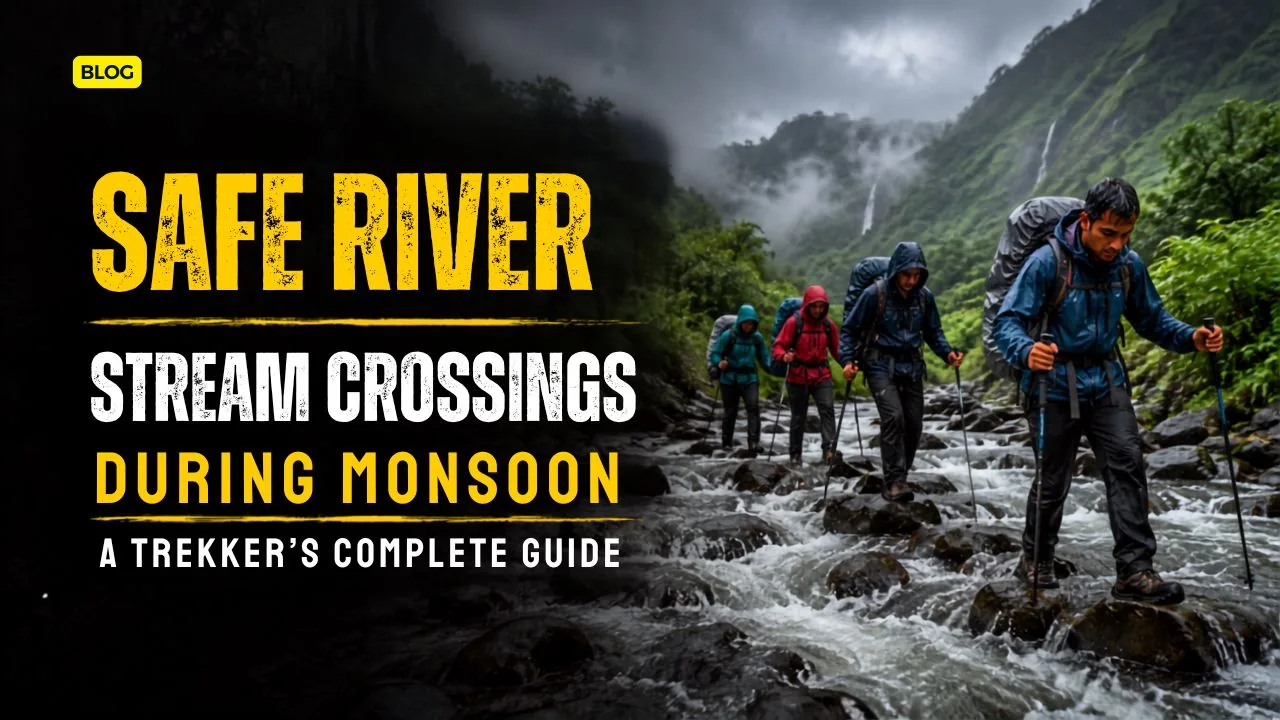
Introduction
Some of the most beautiful moments on a monsoon trek happen near water. Streams tumble down every slope, waterfalls roar to life, and crossing a clear mountain brook can feel like the highlight of the day. Learning safe river and stream crossings during monsoon is what keeps those moments joyful instead of risky.
Water is the one part of a monsoon trail that changes fast and demands respect. A stream that's ankle-deep in the morning can be knee-deep and pushy by afternoon. The skill isn't about fearing water. It's about reading it, choosing the right spot, and knowing the moment to say "not today."
This guide covers how to judge depth and current, the right footwear, how to actually cross, when a rope helps, and the clear signals that mean turn back. Get these right and monsoon streams become one of the season's great pleasures.
Table of Contents
- Why Monsoon Water Crossings Deserve Respect
- How to Read a Crossing: Depth and Current
- Choosing the Right Spot to Cross
- Footwear and What to Do With Your Gear
- How to Cross Safely, Step by Step
- Using Ropes and Group Techniques
- When to Turn Back: The Non-Negotiables
- Flash Floods and Rising Water
- Practical Tips
- Common Mistakes
- Expert Insights
- Frequently Asked Questions
- Ready for Your Next Adventure?
Why Monsoon Water Crossings Deserve Respect
Moving water is deceptively powerful. It doesn't take a deep river to knock you off balance. Fast-moving water just above the knee can sweep an adult off their feet, because the force of a current rises sharply with its speed.
Monsoon adds two twists in the Sahyadri:
- Water levels change quickly. Rain falling kilometers upstream can raise a stream long after the rain near you has stopped.
- The bottom is hidden. Muddy monsoon water hides loose rocks, slippery boulders, and sudden drops.
This is why crossings that look casual in dry season need care in monsoon. None of it makes water crossings something to avoid. It simply means you read the water first and cross with a plan, exactly the mindset that makes monsoon trekking so rewarding when done right. Water is just one monsoon hazard — our broader monsoon trekking safety guide covers the rest.
How to Read a Crossing: Depth and Current
Before anyone steps in, spend a minute reading the water. This quick habit prevents almost every crossing problem.
Judging depth:
- Look for a stretch where the water is clearly shallow, ideally below the knee.
- Use a trekking pole or a stick to probe ahead of your feet as a depth check.
- Be honest about the strongest member vs the weakest. The crossing has to be safe for everyone, not just the tallest.
Judging current:
- Watch how fast debris or foam moves across the surface. Fast water is stronger than it looks.
- Smooth, glassy water can be deep and fast; choppy, broken water over rocks is often shallower but trickier underfoot.
- Listen. A loud, roaring stream is usually carrying more force than a gentle one.
A simple test many trekkers use: if the water is above the knee and moving fast enough to push against your leg, treat the crossing as high-risk. Above mid-thigh in a current, the answer is usually no.
Choosing the Right Spot to Cross
The obvious crossing point is often not the best one. A short walk up or down the bank can reveal a far safer spot.
Look for:
- The widest part of the stream, where water spreads out and runs shallower and slower.
- A stretch with no obstacles downstream (no waterfalls, rapids, or deep pools) in case someone slips.
- A firm, visible bottom rather than deep mud or big, wobbly boulders.
- A gentle exit bank you can climb out on easily.
Avoid:
- Narrow points where the same water squeezes through faster and deeper.
- Bends, where the current runs strongest on the outside edge.
- Just above a waterfall or rapid, where a slip has serious consequences.
- Slick rock slabs with a film of water over them.
Scouting the right spot is worth every minute it takes. Local guides often know exactly where a given stream is safest to cross, which is one of many reasons their knowledge is gold in monsoon.
Footwear and What to Do With Your Gear
A common instinct is to remove shoes and cross barefoot to keep them dry. On monsoon streams, this is usually a mistake.
Footwear for crossings:
- Keep your trekking shoes on. They protect your feet from sharp rocks and give you grip on slippery bottoms. Wet shoes are a small price for stable footing.
- Some trekkers carry sandals with a back strap for crossings, which is fine as long as they grip and won't slip off. Flip-flops are not suitable.
- Never cross barefoot on hidden, rocky monsoon bottoms.
Managing your gear:
- Loosen your backpack's hip belt and chest strap before crossing. If you fall, you want to shed the pack instantly so it doesn't pin you or drag you down.
- Waterproof the important stuff (phone, documents, dry layers) in a bag inside your pack.
- Use a trekking pole or a sturdy stick as a third point of contact and a probe.
The pack point is important and often overlooked. A buckled-tight pack full of water is heavy and dangerous in a current, so being able to ditch it fast is a genuine safety measure.
How to Cross Safely, Step by Step
Once you've read the water and picked your spot, cross with a clear technique.
- Face slightly upstream and angle your crossing downstream, working with the current rather than fighting straight across it.
- Unbuckle your pack straps so you can drop it in an emergency.
- Use a pole or stick on your upstream side for a stable third point. Move the pole, plant it, then move a foot.
- Shuffle, don't stride. Keep both feet in contact with the bottom, sliding them along rather than lifting high.
- Move one point of contact at a time. Two feet and a pole means you always have two anchors down.
- Keep your body low and balanced, knees soft, weight slightly into the current.
- Don't look at the rushing water, which can make you dizzy. Focus on your exit point on the far bank.
Take it slow. There are no points for speed, only for arriving on the other side steady and dry-headed.
Using Ropes and Group Techniques
For wider or pushier crossings, working as a group adds a big margin of safety.
Group techniques:
- The line or huddle method: Several trekkers link arms or hold onto each other's shoulders and cross together as a stable unit, with the strongest members on the upstream side.
- Send the strongest first and last. A confident crosser establishes the route, and another anchors the group from behind.
- Cross one person at a time on harder sections while others spot from the bank.
When a rope helps:
- A fixed hand line strung across a crossing gives everyone something secure to hold. This is a technique guides set up on established monsoon routes like certain valley and waterfall trails.
- Never tie yourself directly to a rope across moving water in a way you can't release instantly. Being unable to detach in a current is dangerous. Ropes are hand support, not a harness anchor, unless set up by trained hands.
Rope work is genuinely a skill. On serious water crossings, having someone who's done it many times before makes all the difference, which is why guided monsoon treks handle these sections so calmly.
When to Turn Back: The Non-Negotiables
The bravest, smartest decision on any monsoon trek is sometimes to not cross. There's no trophy for forcing a dangerous crossing.
Turn back or wait when:
- The water is above mid-thigh in any noticeable current.
- The current is strong enough to push you as you test the edge.
- The water is rising while you watch (a serious warning sign).
- The bottom is invisible and you can't find a safe depth anywhere along the bank.
- There's a waterfall, rapid, or deep pool just downstream.
- A member of the group isn't confident and there's no safe way to support them across.
- Light is fading and a wet, tricky crossing would leave you descending in the dark.
Waiting an hour or two often lets a flash-swollen stream drop back to a safe level. If it doesn't, turning around is a complete success, not a failure. The trail will be there next weekend.
Flash Floods and Rising Water
Flash floods are the one water hazard that can arrive with little warning, so they deserve their own habits.
Stay flash-flood aware:
- Rain upstream matters even under a clear sky above you. Water travels down the catchment and can raise a stream suddenly.
- Muddy, debris-filled water or a rising level means heavy rain has fallen higher up. Get out of the streambed.
- Don't camp or take long breaks in a dry or shallow streambed during monsoon; these can fill fast.
- If a stream is rising as you approach, don't cross. Wait on high ground for it to peak and fall.
- Cross important streams early in the day, before afternoon rain swells them for the return.
That last point is a quiet pro habit: plan the route so you're not stuck on the far side of a stream that's grown too big to recross on the way back. This is exactly why canyon treks like Sandhan Valley are strictly off-limits in the rains.
Practical Tips
- Scout up and down the bank before choosing where to cross.
- Probe every step with a pole in muddy monsoon water.
- Keep shoes on and pack straps loose at every crossing.
- Cross the biggest streams early, before afternoon rain raises them.
- Waterproof your phone and dry layers in an inner bag.
- Face upstream, shuffle your feet, and aim for a downstream exit.
- Agree a "no-cross" rule as a group before the trek, so nobody feels pressured in the moment.
- When trekking with an organizer, let the leader set up and call the crossing; they know each route's safe spots.
Common Mistakes
- Crossing at the narrowest point because it looks shortest, where water runs deepest and fastest.
- Removing shoes to keep them dry, losing grip and foot protection on rocky bottoms.
- Keeping the backpack buckled tight, which becomes a hazard if you fall.
- Underestimating knee-deep current, which is stronger than it looks.
- Ignoring rising or muddy water instead of treating it as a stop signal.
- Rushing across rather than shuffling steadily with a pole.
- Crossing late in the day and getting stuck on the far side after rain swells the stream.
- Pushing a nervous group member across a crossing that's beyond them.
Expert Insights
Guides who lead monsoon water treks share a consistent philosophy: the crossing decision is made before anyone's feet are wet. They read the water, scout the bank, and decide as a team, which removes the in-the-moment pressure that leads to bad calls.
They also time the whole route around the water. On trails with significant crossings, an experienced leader plans to cross early, watches the sky and the stream all day, and keeps a fallback plan if levels rise. This foresight is what keeps monsoon treks flowing smoothly through some of the wettest, most beautiful terrain in the Sahyadri.
And they treat turning back as completely normal. In a well-led group, calling off a crossing earns respect, not disappointment, because everyone understands that the mountains and the monsoon set the terms. That calm, water-smart culture is one of the real advantages of trekking with a seasoned team during the rains.
Frequently Asked Questions
1. How deep is too deep to cross a stream on foot? As a rough guide, water above the knee in a noticeable current is high-risk, and above mid-thigh in any current usually means don't cross. Depth alone isn't the whole story; current strength matters just as much.
2. Should I take my shoes off to cross a river? No. Keep your trekking shoes on for grip and to protect your feet from hidden sharp rocks. Wet shoes are a small trade for stable, safe footing on a slippery monsoon bottom.
3. How do I read a river's current before crossing? Watch how fast surface foam or debris moves, listen for a roaring sound, and test the edge with a pole. Fast, pushy, or rising water is a warning to find a better spot or wait.
4. What's the safest way to cross a stream in a group? Link arms or shoulders and cross together as a stable unit with the strongest members upstream, or use a fixed hand line set up by an experienced leader. Move slowly and keep contact with the bottom.
5. When should I turn back at a river crossing? Turn back if the water is above mid-thigh in a current, is rising, hides an unreadable bottom, or sits just above a waterfall or rapid. Waiting for levels to drop or rescheduling is always the safe choice.
6. What should I do with my backpack when crossing? Loosen the hip belt and chest strap so you can shed the pack instantly if you fall. Waterproof valuables inside, and never cross with a pack cinched tight in strong water.
7. Are flash floods a real risk in the Sahyadri? Yes. Rain falling upstream can raise a stream quickly even under clear skies near you. Watch for rising, muddy water, avoid resting in streambeds, and cross major streams early in the day.
Safe river and stream crossings during monsoon come down to a few clear habits: read the water, pick the widest calm spot, keep your shoes on and straps loose, cross low and slow with a pole, and know the exact conditions that mean turn back. Respect rising and muddy water, and cross the big streams early.
Water is the heartbeat of a monsoon trek. Treat it with respect and a plan, and those roaring streams and glistening crossings become the very reason the rainy-season Sahyadri is so unforgettable.
Ready for Your Next Adventure?
Don't just read about it — come experience it. Book your spot on Monsoon Special Treks with certified trek leaders, small groups, and everything organised for you.
🏷 how to cross a river safely while trekking, monsoon stream crossing safety, river crossing techniques for hikers, when to turn back at a river crossing, flash flood safety trekking, how deep water is safe to cross on foot
Be the first to comment on this post.